Food Security Challenges in Nepal: Assessing the Existing Situation and Policy-level Strategies for Mitigation and Resilience
Aashish Kumar Sharma
*

Department of Plant Pathology, School of Agriculture, Lovely Professional University, Phagwara, Punjab, 144411, India.
Robin Rijal
Natural Resources Institute of University of Greenwich, Central Avenue, Chatham Maritime, Chatham, Kent, ME4 4TB, UK.
Sittal Thapa
Department of Genomics, Phenomics and Bioinformatics, North Dakota State University, Fargo, ND, 58102, USA.
Subash Thapa
Department of Agronomy, Horticulture and Plant Science, South Dakota State University, Brookings, SD, 57006, USA.
Akash Shah
Department of Agronomy, West Florida Research and Foundation Centre, University of Florida, Jay, FL, 32565, USA.
Prajina Neupane
Department of Soil and Crop Sciences, Texas A&M University, College Station, TX 77843, USA.
Shree Bhagavan Thakur
Madhesh Agricultural University, Rajbiraj, Saptari, Madhesh Province, 56400, Nepal.
*Author to whom correspondence should be addressed.
Abstract
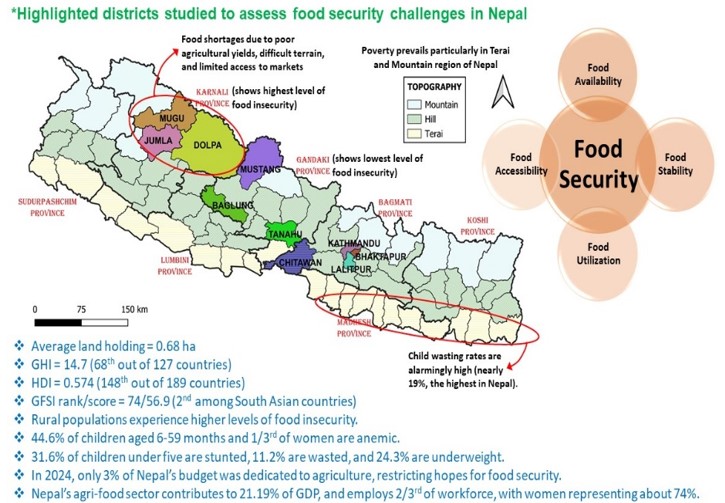
Food security in Nepal remains a pressing issue, defined by consistent access to sufficient, safe, and nutritious food aligned with cultural and dietary needs. While Nepal’s Global Hunger Index improved from 37.1 in 2000 to 14.7 in 2024, around 13% of the population still faces moderate to severe food insecurity, with Karnali Province most affected (32%). The agri-food sector, which contributes 21.2% to GDP and employs two-thirds of the population, is vulnerable to climate change, soil degradation, and poor infrastructure. In addition, climate-induced disasters cause annual losses of 1.5–2% of GDP, worsening food availability. Malnutrition remains widespread, with high rates of stunting, wasting, and anaemia among children and pregnant women. Moreover, emigration has led to labor shortages and a decline in agricultural productivity, while remittances, contributing 26.6% to GDP, have shifted food practices towards market dependency, reducing food sovereignty. This review explores the complex interplay of socio-economic, environmental, and governance challenges affecting food security in the country. It highlights the inefficacy of existing policies, such as the Climate Change Policy (2019) and the National Adaptation Program of Action (2010), due to weak governance and political instability. The interplay of demographic factors, such as gender roles, education levels, and household dynamics, further shapes food security outcomes; therefore, achieving food security in Nepal requires a holistic approach, prioritizing climate-resilient agriculture, equitable resource distribution, and inclusive policy implementation. Since addressing food insecurity in Nepal is not just a matter of policy but a moral imperative to safeguard the health, dignity, and well-being of all its people, fostering collaboration among stakeholders and prioritizing the needs of the most vulnerable are essential steps toward a future where no one is left behind in the pursuit of food security and prosperity.
GRAPHICAL ABSTRACT
Keywords: Food security, food insecurity, Nepal, National, agriculture, government, policies